
Should I Install a NEMA 14-50 Outlet for My EV Charger?
If you’re preparing to install a Level 2 EV charger, you’ve probably come across the term NEMA 14-50 outlet.
Many electric vehicle owners assume it’s the standard way to charge at home—but is it the best option?
The answer depends on your vehicle, the charger you choose, your home’s electrical system, and your long-term plans.
For some homeowners, a NEMA 14-50 outlet is an excellent solution. For others, a hardwired charger offers greater performance, safety, and convenience.
At Car Charger Specialists, we help homeowners choose the charging setup that best fits their needs. In this guide, we’ll explain what a NEMA 14-50 outlet is, how it works, and when it’s the right choice.
Schedule Your Free Consultation!
What Is a NEMA 14-50 Outlet?
A NEMA 14-50 is a 240-volt electrical receptacle commonly used for high-powered appliances such as electric ranges and recreational vehicles (RVs).
In recent years, it has also become one of the most popular outlet types for Level 2 EV charging.
Instead of permanently wiring the charger into your home’s electrical system, a compatible EV charger simply plugs into the outlet.
Think of it as the heavy-duty version of a standard household outlet.
Why Is the NEMA 14-50 So Popular?
Several EV manufacturers and charger manufacturers support NEMA 14-50 connections because they offer flexibility.
Benefits include:
- Widely available
- Compatible with many EV chargers
- Easier charger replacement
- Portable if you move
- Lower installation costs in some situations
- Familiar electrical configuration
Many homeowners appreciate the ability to unplug one charger and replace it with another without rewiring the circuit.
How Fast Can a NEMA 14-50 Charge My EV?
A properly installed NEMA 14-50 outlet is typically connected to a 50-amp circuit.
Because EV charging is considered a continuous electrical load, the National Electrical Code limits charging to 80% of the circuit rating.
That means most chargers plugged into a NEMA 14-50 outlet deliver a maximum of 40 amps.
Depending on your vehicle, that’s enough to add approximately:
- 25 to 35 miles of driving range per hour
- A full overnight charge for most EVs
- Plenty of charging capacity for the average commuter
For many homeowners, a 40-amp charging rate is more than sufficient.
Which Vehicles Can Use a NEMA 14-50 Outlet?
Many popular electric vehicles can charge using a compatible portable or plug-in Level 2 charger.
Examples include:
- Tesla (with the appropriate adapter or Mobile Connector)
- Ford F-150 Lightning
- Ford Mustang Mach-E
- Rivian R1T
- Rivian R1S
- Hyundai IONIQ 5
- Kia EV6
- Kia EV9
- Chevrolet Equinox EV
- Chevrolet Blazer EV
- Nissan Ariya
- Volkswagen ID.4
- Volvo EX30
- Polestar 2
Your vehicle doesn’t plug directly into the outlet—the EV charger plugs into the outlet, and your charging cable connects the charger to your vehicle.
When Is a NEMA 14-50 Outlet a Good Choice?
A NEMA 14-50 outlet may be the right option if you:
- Want flexibility to change chargers in the future
- May move to another home
- Prefer using a portable charging unit
- Drive average daily distances
- Don’t need the fastest possible home charging speeds
- Already own a charger designed for plug-in installation
Many homeowners appreciate having the option to unplug the charger without hiring an electrician.
When Is a Hardwired Charger the Better Choice?
Although NEMA 14-50 outlets are popular, they’re not always the best solution.
Hardwired chargers offer several advantages.
Faster Charging
Many hardwired chargers support 48-amp charging, while most NEMA 14-50 installations are limited to 40 amps.
That translates into faster charging for vehicles capable of accepting higher charging rates.
Fewer Electrical Connections
A hardwired installation eliminates the plug and receptacle.
With fewer connection points, there are fewer opportunities for wear over time.
Cleaner Appearance
Many homeowners prefer the streamlined look of a permanently mounted charger with concealed wiring.
Improved Durability
Frequent plugging and unplugging can eventually wear out a receptacle.
Hardwired chargers are intended to remain permanently connected and generally experience less mechanical wear.
Future-Proofing
As electric vehicles continue to evolve, many manufacturers are designing chargers that take advantage of higher charging capacities available through hardwired installations.
Are NEMA 14-50 Outlets Safe?
Yes—when installed correctly.
A professionally installed NEMA 14-50 outlet should include:
- Proper wire sizing
- Correct breaker size
- GFCI protection where required
- High-quality industrial-grade receptacle
- Proper torque specifications
- Code-compliant installation
One common mistake is using inexpensive residential-grade outlets for continuous EV charging.
Lower-quality outlets can loosen over time, potentially leading to overheating.
At Car Charger Specialists, we install commercial-grade components designed for long-term EV charging applications.
Can I Install a NEMA 14-50 Myself?
While some experienced homeowners may be permitted to perform electrical work in certain jurisdictions, installing a 240-volt circuit involves significant safety considerations.
Improper installation can result in:
- Electrical shock
- Fire hazards
- Overheated wiring
- Damaged charging equipment
- Failed inspections
- Warranty concerns
Professional installation helps ensure the circuit is properly sized, protected, and compliant with local electrical codes.
What Does a NEMA 14-50 Installation Require?
A typical installation includes:
- Dedicated 240-volt circuit
- 50-amp breaker
- Proper wire gauge
- Quality NEMA 14-50 receptacle
- Appropriate electrical box
- Permit (where required)
- Final testing
The exact installation depends on your home’s electrical panel location, available capacity, and the distance between the panel and the charging location.
Will I Need an Electrical Panel Upgrade?
Not necessarily.
Many homes already have sufficient electrical capacity to support a NEMA 14-50 outlet.
Before installation, a licensed electrician should evaluate:
- Available electrical capacity
- Existing household loads
- Breaker space
- Panel condition
- Future charging needs
A professional load calculation helps determine whether any upgrades are necessary.
Related Guide: Can My Electrical Panel Handle an EV Charger?
What If I Plan to Buy Another EV?
If your household expects to own multiple electric vehicles in the future, it’s worth thinking beyond today’s installation.
A hardwired charger—or a smart charging system—may offer better long-term flexibility, especially if you later add a second charger or higher-capacity vehicle.
Planning ahead can reduce future installation costs and simplify upgrades.
NEMA 14-50 vs. Hardwired: Quick Comparison
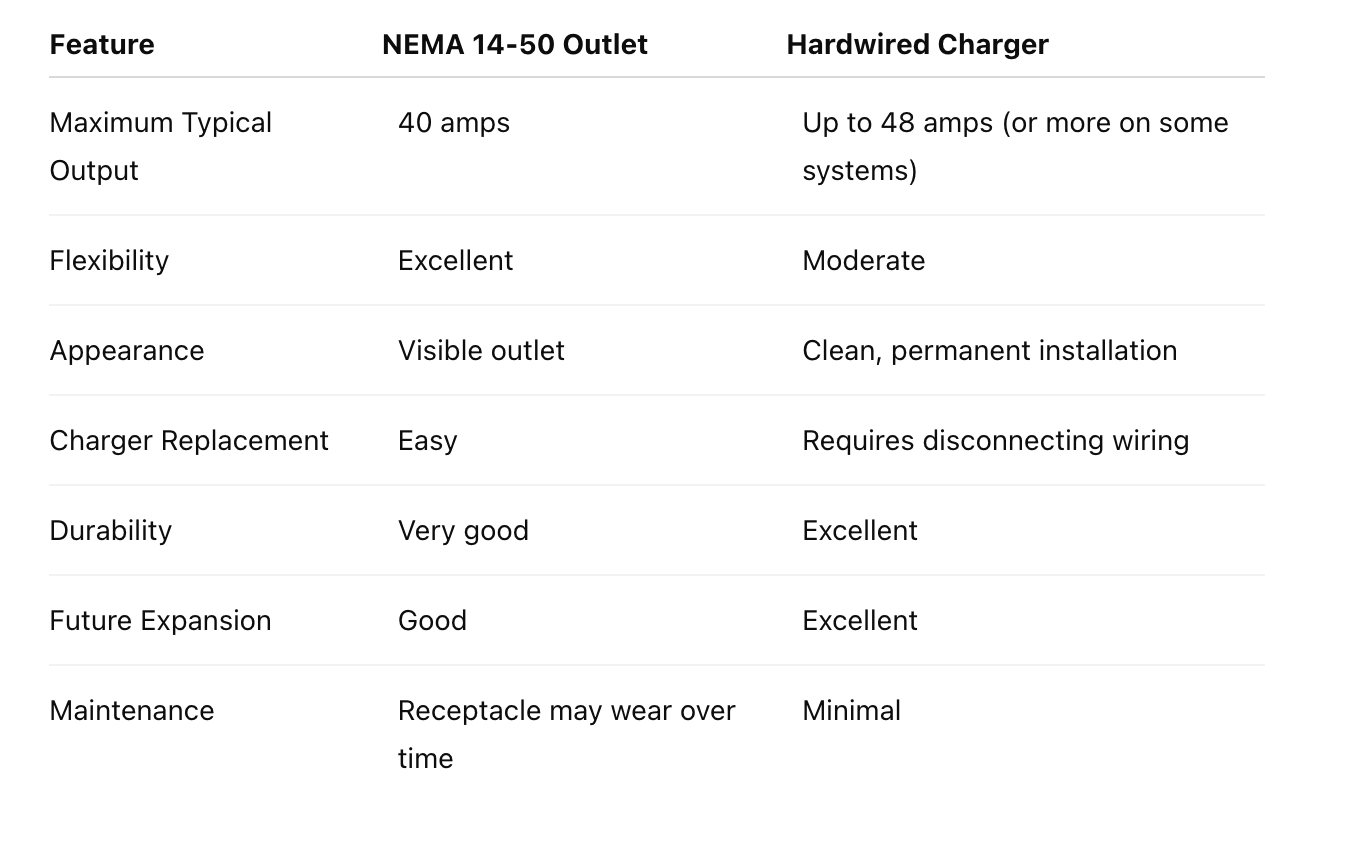
Both options can provide reliable, safe charging when installed correctly.
Why Homeowners Choose Car Charger Specialists
Choosing between a NEMA 14-50 outlet and a hardwired charger isn’t just about convenience—it’s about selecting the right solution for your vehicle, your home, and your future.
Car Charger Specialists provides:
- Professional EV charger consultations
- NEMA 14-50 outlet installation
- Hardwired EV charger installation
- Electrical panel evaluations
- Load calculations
- Permit assistance
- Code-compliant installations
- Residential and commercial EV charging solutions
We’ll help you determine which installation method offers the best combination of performance, flexibility, and long-term value.
Schedule Your EV Charger Installation
Whether you’re considering a NEMA 14-50 outlet or a permanently hardwired charger, choosing the right installation today can improve charging performance and prepare your home for future electric vehicles.
The experts at Car Charger Specialists can evaluate your home’s electrical system, recommend the best charging solution, and provide professional installation that meets all applicable electrical codes.
Contact Car Charger Specialists today to schedule your home EV charger consultation and enjoy safe, reliable charging for years to come.
30+ Years of experience
Licensed & Trusted by thousands
Frequently Asked Questions
Is a NEMA 14-50 outlet required for an EV charger?
No. Many EV chargers are designed to be permanently hardwired instead of plugged into an outlet.
Is a hardwired charger faster?
In many cases, yes. Hardwired chargers often support higher charging rates than plug-in models.
Can I unplug my charger and take it with me?
Yes. One advantage of a NEMA 14-50 installation is that compatible chargers can easily be unplugged and moved.
Does Tesla use a NEMA 14-50 outlet?
Tesla offers charging equipment compatible with NEMA 14-50 outlets, including its Mobile Connector with the appropriate adapter. Many Tesla owners also choose the permanently installed Tesla Wall Connector.
Which option lasts longer?
Both can provide years of reliable service when installed properly. However, hardwired installations eliminate the receptacle, reducing mechanical wear from repeated plugging and unplugging.
Recommended Links
- How Many Amps Do I Need for a Level 2 Charger?
- Can My Electrical Panel Handle an EV Charger?
- Hardwired vs. Plug-In EV Chargers
- Best Charger for Tesla
- Residential EV Charger Installation
- EV Charger Installation Cost (future page)
- Level 2 EV Charger Guide (future page)
